

The 2026 Venezuela Earthquakes
What Happened
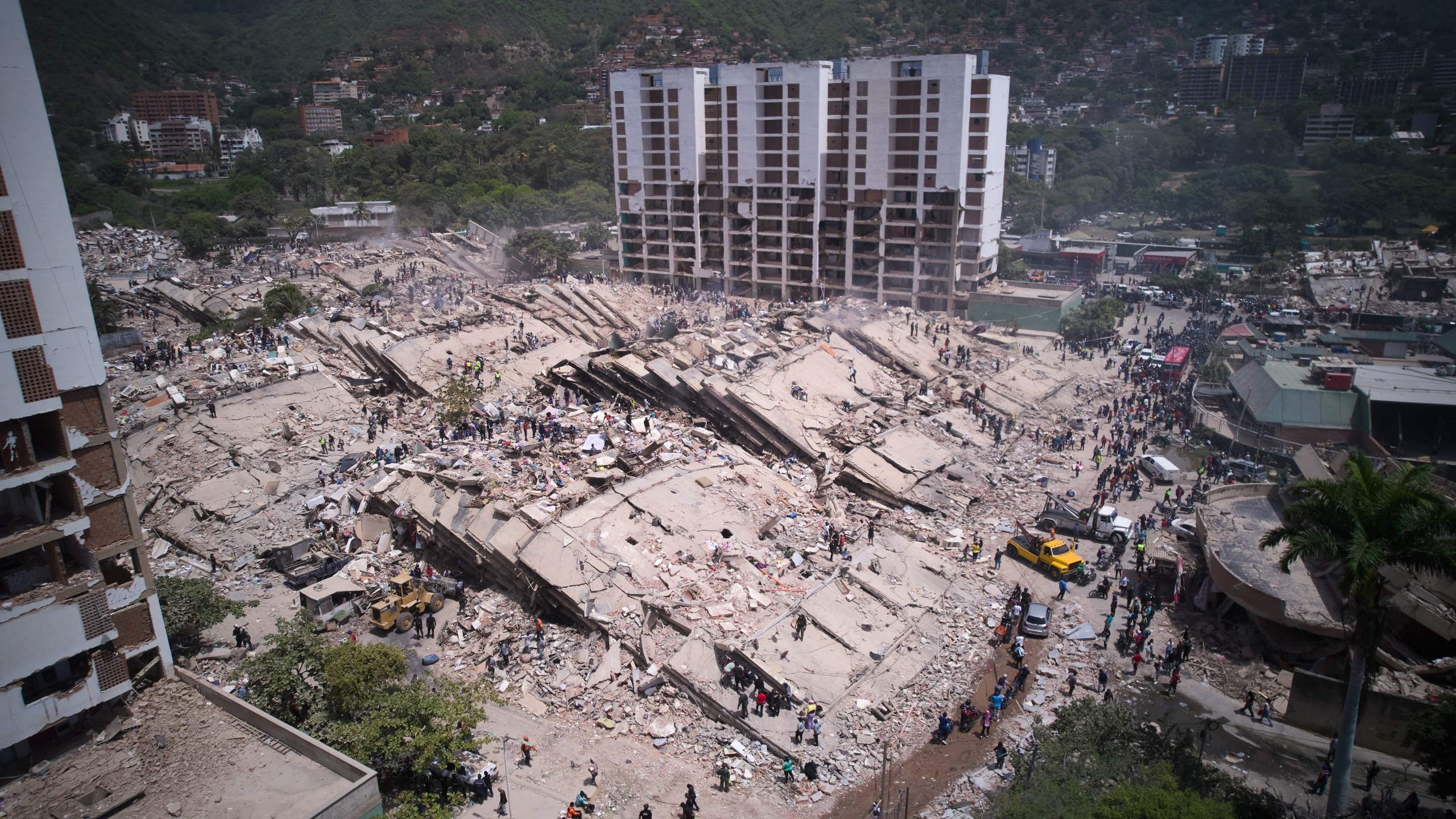
On 24 June 2026, Venezuela experienced one of the most devastating natural disasters in its recent history.
Within just 39 seconds, two major earthquakes struck north-central Venezuela. According to the U.S. Geological Survey (USGS), the first earthquake measured magnitude 7.2, followed almost immediately by a second, even stronger magnitude 7.5 earthquake. Seismologists describe this rare sequence as a seismic doublet—two large earthquakes occurring so closely in time and space that the first rupture may have transferred stress to a nearby fault, triggering the second event.
The earthquakes occurred along the boundary between the Caribbean Plate and the South American Plate, where the plates move horizontally past one another along major right-lateral strike-slip faults. Although strike-slip earthquakes do not usually generate large tsunamis, they can produce extremely destructive ground shaking, particularly when they occur at shallow depths beneath populated areas.
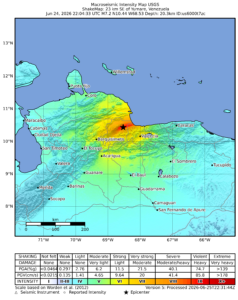
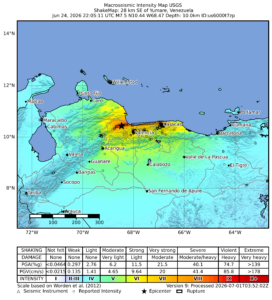
Shake maps from both earthquakes
Why local geology matters
The severity of an earthquake is determined not only by its magnitude, but also by where and how buildings are constructed.
Local geology plays a critical role in how seismic waves travel through the ground. Soft sediments and unconsolidated soils can amplify ground shaking compared with solid bedrock, increasing the demands placed on buildings during an earthquake.
One of the areas most severely affected by the 2026 earthquakes was La Guaira, a region that also experienced the catastrophic Vargas tragedy of 1999, when intense rainfall triggered massive landslides and debris flows that reshaped the landscape and caused widespread loss of life.
Over the years, parts of the region have been rebuilt on deposits left behind by those landslides. Seismologists and geotechnical engineers will now study whether local soil conditions influenced the distribution and severity of earthquake damage. Such investigations are a standard part of understanding why some buildings experience much greater damage than others during the same earthquake.
Earthquake damage is rarely controlled by a single factor. Instead, it reflects the combined effects of the earthquake itself, local geology, building design, construction quality, and preparedness.
A disaster whose consequences continue
Nine days after the earthquakes, the humanitarian emergency continues.
Search-and-rescue teams have been working around the clock in the hope of finding survivors beneath collapsed buildings. As time passes, the probability of rescuing people alive naturally decreases, and the response gradually shifts toward emergency medical care, temporary shelter, safe drinking water, food distribution, and long-term support for affected communities. Even so, rescue operations continue whenever there is reason to believe someone may still be trapped.
Many communities continue to face damaged infrastructure, disrupted communications, and limited access to essential services. Aftershocks remain a concern, and engineers continue evaluating buildings before residents can safely return, if there is a building to return to. Preliminary scientific assessments indicate widespread structural damage, with additional hazards including landslides and liquefaction in some areas. The USGS estimated a high likelihood of severe humanitarian impacts because of the earthquake magnitudes, their shallow depth, and the number of people exposed to intense ground shaking.
The full extent of the human, social, and economic impact will only become fully understood over the coming weeks and months.
The humanitarian response
The humanitarian response has also faced significant challenges.
Years of economic hardship and institutional deterioration had already weakened parts of the country’s infrastructure and emergency response capacity before the earthquakes occurred. In the days following the disaster, humanitarian organizations, journalists, and rescue teams reported logistical and administrative difficulties that complicated relief efforts. Reports also described obstacles affecting the rapid deployment of some humanitarian assistance and emergency response resources.
Large-scale disasters demand rapid coordination, effective institutions, and unhindered humanitarian access. Every delay in providing search-and-rescue equipment, emergency medical care, safe water, shelter, and humanitarian assistance can have profound consequences for those waiting to be rescued or supported.
Preliminary satellite assessment
A preliminary analysis by NASA estimates that approximately 58,870 buildings may have been damaged or collapsed across Venezuela following June 24th’s twin earthquakes. The estimate is based on a rapid analysis of satellite imagery aimed at assessing the extent of structural damage in the affected areas.
NASA stresses that these figures are preliminary and subject to revision as additional satellite data, field assessments and official reports become available. While damage assessments continue, one thing is already clear: thousands of families urgently need support. Source
How you can help
At this stage of the response, financial donations remain the most effective way to help.
Monetary donations allow experienced humanitarian organizations already working on the ground to respond where needs are greatest and to adapt as the situation evolves. Your support helps provide:
• Search-and-rescue operations where they are still ongoing
• Emergency medical care
• Temporary shelter
• Safe drinking water
• Food assistance
• Essential supplies
• Recovery support for affected communities
If you wish to support earthquake relief efforts, we encourage you to donate directly to established humanitarian organizations with the capacity to respond effectively.
• HEKS
• Caritas
• Save the Children
• Helvetas
• Swiss Solidarity
• Chaîne du Bonheur
• UNICEF
• UN Crisis Relief
A personal message from Katherine Klemenz,
Founder and President of Mama Tierra
Dear friends of Mama Tierra
Venezuela needs help now.
I am writing this message with a heavy heart.
In the wake of the devastating earthquakes, countless families have been left with nothing. Homes have been destroyed, people are still missing, the injured need medical care, and many survivors lack safe access to drinking water, food, and hygiene supplies.
For me, Venezuela is not a distant country.
My family is from there. I have lived and worked there. I know this country, its people, its strength, but also its great vulnerability when a disaster strikes a nation that was already under enormous pressure.
That is why I cannot simply stand by and watch.
Mama Tierra supports HEKS’s appeal for donations to provide emergency aid in Venezuela. HEKS has been working with local partner organizations on the ground for years. What’s particularly important to us is that we know the project manager personally. This gives us confidence that the aid will be managed responsibly, rooted in the local community, and deployed where it’s needed most urgently right now.
Every hour counts at this stage. The hope of rescuing people alive from the rubble is dwindling. This makes aid for the survivors all the more urgent.
Medical care is needed.
Clean drinking water is needed.
Food is needed.
Hygiene supplies, blankets, and shelter are needed for families who have lost everything.
Please help now.
Every donation, big or small, sends a message: You are not forgotten. We see you. We are helping.
Fundraiser: Emergency Aid for Venezuela
https://www.heks.ch/schweres-erdbeben-venezuela-heks-startet-soforthilfe
Thank you from the bottom of our hearts for your solidarity, your support, and your trust.
Katherine Klemenz
Founder and President of Mama Tierra
The road ahead
The rescue efforts continue.
The grief continues.
The uncertainty continues.
Some wounds cannot yet be put into words.
Throughout these nine days, one truth has remained impossible to ignore: the extraordinary courage of ordinary Venezuelans.
In the critical hours after the earthquakes, when every minute meant the difference between life and death, it was local residents who searched relentlessly through the rubble with their bare hands. Families searched for loved ones. Friends searched for friends. Neighbours searched for neighbours. Refusing to surrender hope, they worked tirelessly despite the danger, determined to save every life they still could.
As the days passed, firefighters and rescue teams from other regions of Venezuela, together with international search-and-rescue teams, joined these efforts. Yet for countless families, it was the solidarity, courage and determination of ordinary citizens that defined those first desperate hours.
Even today, many continue to help their neighbours, assist rescue teams, and hold on to the hope that someone else might still be found alive.
At Mama Tierra, our thoughts remain with every family whose life has been forever changed by these earthquakes.
We also extend our deepest gratitude to every citizen, volunteer, firefighter, healthcare worker, engineer, pilot, humanitarian organization and rescue professional who has worked tirelessly in service of others. Your courage, compassion and unwavering commitment remind us that even in humanity’s darkest moments, kindness endures.
Thank you for standing with Venezuela.